Introduction: When Talent Is Not Enough
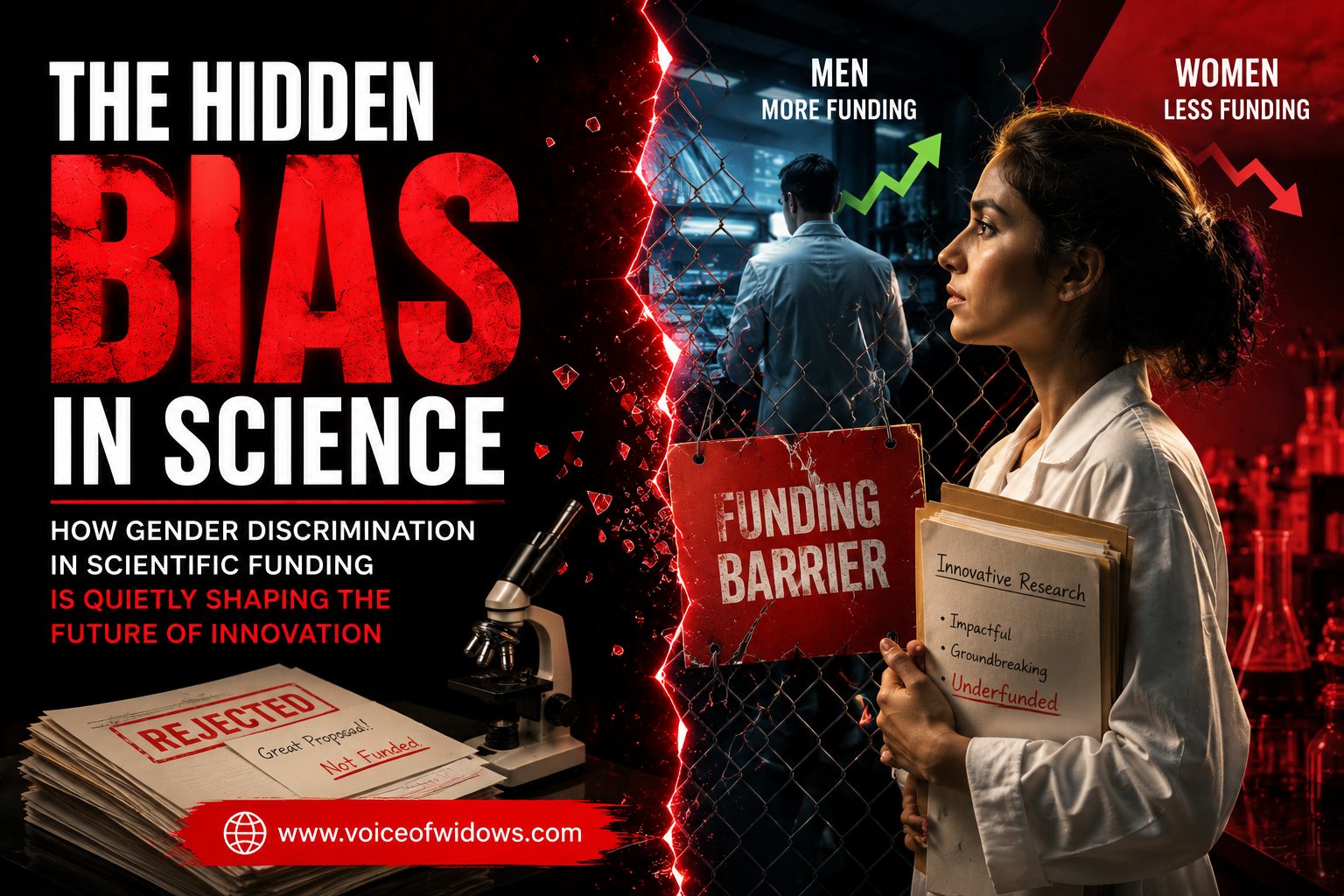
Science is supposed to be the purest form of meritocracy, where ideas compete and evidence decides outcomes. Yet behind the lab doors and grant review panels, a quieter reality persists: gender discrimination in scientific funding is still shaping who gets to discover, innovate, and lead.
This is not just a fairness issue. It is a global innovation problem. Every underfunded researcher is a lost opportunity for breakthroughs in medicine, climate science, engineering, and technology.
The question is no longer whether bias exists, but how deeply it is embedded in systems that decide the future of science itself.
The Invisible Barrier in Research Funding
Scientific funding is often perceived as objective. Proposals are reviewed, scored, and awarded based on merit. But research over the past decades consistently reveals patterns that challenge this belief.
Women researchers, even when equally qualified, are less likely to receive large-scale grants, long-term funding, or leadership positions in high-budget projects. The disparity becomes more visible in fields traditionally dominated by men such as physics, engineering, and computational sciences.
The issue is not always explicit discrimination. It is often subtle, structural, and embedded in evaluation criteria, unconscious bias, networking advantages, and historical inequalities.
How Bias Quietly Enters Funding Systems
Gender discrimination in scientific funding does not usually appear as open exclusion. Instead, it manifests through layered mechanisms:
1. Evaluation Bias
Grant proposals written by women are sometimes judged more critically, with higher scrutiny on methodology and feasibility, while similar proposals from men are evaluated more leniently.
2. Network Advantage
Funding decisions are influenced by professional networks. Historically male-dominated academic circles often provide better access to mentorship, collaborations, and informal endorsements.
3. Leadership Perception
Projects led by men are more likely to be perceived as “high impact” or “high risk-high reward,” even when proposals are scientifically equivalent.
4. Career Interruptions
Women scientists disproportionately experience career breaks due to caregiving responsibilities. Funding systems often fail to account for these disruptions, penalizing productivity gaps.
The Real Cost: What Science Loses
This issue is not limited to individual careers. It reshapes the direction of global research.
When funding is unevenly distributed:
- Entire research perspectives are underrepresented
- Medical studies may overlook gender-specific biological differences
- Innovation pipelines become narrower and less diverse
- Scientific leadership remains unbalanced
The result is not just inequality. It is inefficiency in global knowledge production.
Why This Problem Persists in Modern Science
Despite awareness, gender inequality in funding persists due to deeply rooted structural reasons:
Institutional Inertia
Funding bodies often rely on traditional evaluation frameworks that were not designed to detect bias.
Lack of Accountability
Few systems track long-term gender outcomes in funding distribution.
Implicit Bias
Even well-intentioned reviewers may unconsciously associate leadership and innovation with masculine traits.
Competitive Pressure
High competition for limited funding encourages conservative decision-making, which often favors established, traditionally dominant profiles.
The Emotional Reality Behind the Data
Behind every statistic is a researcher who has spent years building expertise, designing experiments, and pushing the boundaries of knowledge—only to face repeated rejection that cannot always be explained by merit alone.
This creates a silent psychological toll:
- Reduced confidence in grant applications
- Lower participation in high-impact research bids
- Gradual withdrawal from competitive funding arenas
Over time, this does not just affect individuals. It reshapes entire scientific communities.
What Needs to Change: Building Fair Scientific Funding Systems
Addressing gender discrimination in scientific funding requires more than awareness. It demands structural reform.
1. Blind Review Processes
Removing identifying information from proposals can reduce unconscious bias during evaluation.
2. Transparent Funding Metrics
Clear reporting of funding allocation by gender, discipline, and institution can expose hidden disparities.
3. Bias Training for Review Panels
Regular training can help evaluators recognize and mitigate unconscious assumptions.
4. Support for Career Breaks
Funding agencies must adapt criteria to fairly assess productivity across non-linear career paths.
5. Inclusive Leadership in Funding Bodies
Diverse decision-making panels lead to more balanced funding outcomes.
Why This Matters for the Future of Innovation
Science is entering an era defined by complexity—climate change, artificial intelligence, global health crises. Solving these challenges requires every available mind.
If funding systems continue to filter talent through biased structures, the world risks losing transformative discoveries simply because the system failed to recognize them in time.
Equality in scientific funding is not a symbolic goal. It is a strategic necessity for global progress.
Conclusion: A System Worth Redesigning
Gender discrimination in scientific funding is not always visible, but its effects are deeply embedded in the trajectory of science itself. It determines which ideas survive, which researchers lead, and which innovations reach the world.
A fair scientific ecosystem is not one that assumes bias does not exist, but one that actively designs against it.
The future of science depends on whether institutions are willing to question long-standing norms and rebuild funding systems that recognize talent without distortion.
Because when science becomes truly inclusive, innovation does not just improve—it accelerates.