
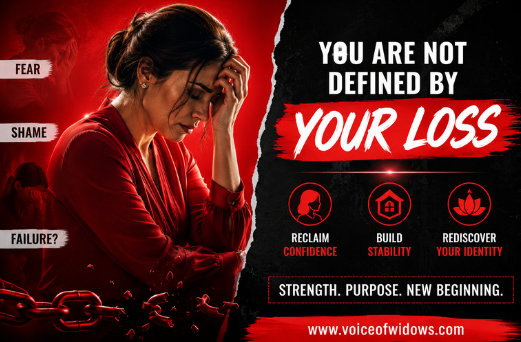
In today’s fast-moving world, many professional widowed women find themselves facing an unexpected emotional and psychological weight that goes far beyond grief alone. While society often assumes that success, education, or career stability can shield someone from emotional collapse, the reality is far more complex. Fear, shame, and an internalized feeling of “failure” can quietly take root even in highly capable, financially independent women. These emotions are rarely spoken about openly, yet they shape decisions, confidence, relationships, and long-term life direction in powerful ways. This is not a story of weakness. It is a story of identity disruption, social pressure, emotional silence, and the invisible expectations placed on women who are expected to “stay strong” while rebuilding life after loss. Understanding why this happens is the first step toward changing it. The silent emotional burden behind professional strength Many professional women are conditioned to perform stability. They are expected to manage careers, families, finances, and emotional responsibilities without visible struggle. When widowhood enters this equation, the emotional shock is often compounded by societal expectations that do not pause for personal loss. Instead of being given space to process grief, many feel an immediate pressure to “function normally” again. This gap between internal emotional reality and external expectations creates a psychological split. On the outside, life may appear controlled. On the inside, there may be confusion, exhaustion, and emotional disorientation. This disconnect often becomes the first seed of shame: the belief that “I should be handling this better.” Why fear becomes dominant after loss Fear in this context is not only emotional—it is practical and existential. It often includes: Fear of financial instability, even when resources existFear of social judgment or being treated differentlyFear of starting over in identity, career direction, or relationshipsFear of being perceived as “incomplete” or “less than” in social spaces For many professional widowed women, the loss is not just of a partner, but of a shared future structure. Even strong career identity does not automatically replace emotional and relational grounding. The mind begins to scan for uncertainty everywhere, which increases anxiety and reduces confidence in decision-making. The hidden layer: shame and internalized expectations Shame is often the most silent emotion. It does not always appear as sadness or anger. Instead, it shows up as withdrawal, overthinking, hesitation, or self-criticism. Some of this shame is internally generated, but much of it is socially absorbed. Cultural narratives often define widowed women through limitation rather than possibility. Even in modern professional environments, subtle bias and unspoken assumptions can reinforce the feeling of being “redefined by loss.” Over time, this can lead to internal questioning such as: “Am I still seen the same way?” “Do I still belong in the same spaces?” “Have I lost value in the eyes of others or even myself?” These questions are not irrational—they are responses to environmental signals, not personal failure. Why the feeling of “failure” is actually misinterpretation The sense of failure many experience after widowhood is rarely about actual capability or achievement. It is more often a mismatch between expected life timelines and reality. Society tends to promote linear life narratives: education, career growth, marriage, stability, continuation. When life disrupts that structure, the brain often interprets deviation as failure rather than transformation. In truth, what is happening is not failure but forced reconstruction of identity under emotional pressure. That distinction is critical. One implies deficiency. The other implies adaptation. How to begin shifting this internal experience Rebuilding after widowhood in a professional context is not about “moving on quickly.” It is about rebuilding internal alignment so that external functioning does not come at the cost of emotional fragmentation. A few key shifts matter deeply: Reframing identity beyond relational statusInstead of seeing identity as defined by marital history, it helps to reconnect with personal values, skills, and long-term purpose that existed before and beyond the relationship. Separating societal perception from self-definitionMuch of shame is reinforced by imagined judgment. Learning to separate external assumptions from internal truth reduces emotional distortion. Allowing grief without performanceMany professionals try to “manage” grief like a task. But grief is not linear productivity—it is emotional integration. Space for processing is not optional; it is necessary for stability. Rebuilding decision confidence graduallyFear often reduces trust in personal judgment. Starting with small, low-risk decisions helps rebuild internal certainty over time. Re-establishing support systems without dependency shameSupport is not weakness. Isolation often intensifies fear and self-doubt. Healthy connection is part of emotional recovery, not a sign of regression. The deeper truth most people miss Widowhood in professional women does not erase capability. It disrupts emotional equilibrium in a way that forces identity reorganization. The fear, shame, and feeling of failure are not indicators of inadequacy—they are signals of transition without sufficient emotional scaffolding. When these emotions are understood instead of suppressed, they begin to lose authority over life choices. What remains underneath is not brokenness, but continuity of identity waiting to be restructured with clarity rather than pressure. The shift does not come from becoming someone new. It comes from integrating loss into identity without letting it define the entirety of it.

Rebuilding the Unbreakable: Mental Strength Strategies Every Widow Deserves to Know
Rebuilding after loss is not a choice; it is a journey that every widow is forced to walk.And while the world moves forward as if nothing happened, you carry a weight that only someone who has lived through it can understand. The silence feels different. The nights feel longer. And the future feels unfamiliar. Yet within that darkness, there is something powerful you must never underestimate: your ability to rise again. This article is not just a set of tips. It is a call to action. A reminder that you are still here, still breathing, still capable of becoming everything life needs you to be. The Journey of a Widow Is Not Survival. It Is Reinvention. People may expect you to simply “move on,” but healing is not a straight road. It is a rebuilding of identity, purpose, and strength. Mental strength is not about ignoring pain; it is about learning how to grow through it. Here are transformative strategies to help you reshape your life from the inside out. 1. Claim Your Right to Feel Everything You don’t have to pretend to be strong every day. You don’t have to hide your tears. Mental strength begins with truth.What you feel is not weakness; it is evidence that you loved deeply. Give yourself space to grieve, to remember, to breathe.Because emotional honesty is the first pillar of resilience. 2. Build a Daily Routine That Protects Your Mind Your mind is your foundation now.Create a routine that supports clarity, calmness, and emotional stability. Focus on: Waking up with intention Practicing slow mornings Walking, journaling, breathing Eating with awareness Sleeping with discipline Every small habit becomes a brick in your rebuilding.Your new life is built through consistency, not intensity. 3. Connect With People Who Pull You Forward You don’t need a crowd; you need a circle.People who understand.People who listen.People who don’t pressure you to be the old version of yourself. Support groups, mentors, friends, community spaces—these connections expand your emotional capacity and reduce the heaviness you carry alone. Mental strength grows when you know you are not fighting alone. 4. Learn How to Calm Your Inner Dialogue The mind of a widow is overloaded—with memories, fears, future worries, and conversations that no longer have replies. Mental strength comes when you learn how to silence the noise. Practice grounding techniques: Slow breathing Repeating anchoring phrases Mind-clearing walks Writing out the thoughts that drain you You cannot control the storm outside, but you can calm the one inside. 5. Redirect Your Identity to Your Future, Not Your Loss You are a widow, but you are also more.Your identity is not defined by what you lost, but by what you choose next. Align yourself with a new purpose:A new dream.A new mission.A new version of who you are becoming. Mental strength grows when you shift from survival mode to growth mode. 6. Set Strong Emotional Boundaries You are allowed to say no.You are allowed to take time.You are allowed to protect your mental space. Not everyone deserves access to your healing process.Boundaries are not walls; they are shields that help you rebuild without interruption. 7. Invest in Your Personal Growth Healing is not only emotional, it is transformational. Learn a new skill.Start a new project.Read, study, expand.Take back control of your mental landscape. Growth is the ultimate form of strength.It tells your mind: I am not stopping here. 8. Believe That You Can Rise Higher Than Before Loss was not the end of your story.It was the beginning of a new chapter that demands courage, resilience, and self-trust. Your future is not over.Your purpose is not gone.Your capacity for joy is still alive, waiting for you to reclaim it. Mental strength is not something you find by chance.It is something you build by choosing, every day, not to give up on yourself. And today, you choose to rise.