

In the world of research funding, numbers often appear neutral. Grant applications are reviewed, scored, and either approved or rejected. But behind this seemingly objective system lies a pattern that is becoming increasingly difficult to ignore: women researchers experience disproportionately higher grant rejection rates in many academic and scientific funding systems. This is not just a statistical concern. It is a structural issue that affects innovation, slows scientific progress, and quietly reshapes who gets to define the future of knowledge. The Hidden Reality Behind Grant Rejections On paper, grant review processes are designed to be fair. Panels evaluate proposals based on originality, methodology, feasibility, and impact. Yet multiple studies across academic institutions and funding bodies reveal that proposals led by women are often judged more harshly, especially when evaluators are aware of the applicant’s identity. The problem is not always explicit bias. In many cases, it is subtle: tone perception, leadership assumptions, and credibility framing. Research proposals written by women are more likely to be described as “less ambitious” or “too cautious,” even when the scientific merit is identical to those written by men. This creates a quiet but persistent disadvantage that compounds over time. Why This Matters More Than It Seems Grant funding is not just money. It is access. It determines who gets labs, who builds teams, who publishes influential papers, and who becomes a leader in their field. When women researchers face higher rejection rates, the impact extends far beyond individual careers: Entire fields lose diversity of thought Research priorities become skewed Innovation potential is reduced Early-career women scientists are pushed out of academia The system does not just filter proposals. It shapes the future of science itself. The Emotional Cost Behind the Data Behind every rejected grant is not just a failed application but often years of preparation, unpaid intellectual labor, and emotional investment. Many women researchers report the same pattern: repeated rejection despite strong peer feedback, delayed career progression, and the constant pressure of needing to “prove” competence more than their male counterparts. Over time, this leads to what many describe as silent attrition—highly capable researchers leaving academia not because they lack ability, but because the system repeatedly signals that their work is less valued. The Structural Gaps Nobody Talks About The issue is not simply individual bias. It is embedded in structural layers: Review panels lacking gender diversity Evaluation criteria favoring traditionally “masculine-coded” research language Network-based funding advantages that exclude newcomers Citation and visibility gaps that influence perceived credibility Institutional inertia resisting reform Even when policies are introduced to improve fairness, implementation gaps often dilute their impact. What Needs to Change Now Solving this problem is not about lowering standards. It is about correcting distortion in evaluation. Funding systems must move toward: Blind review processes wherever possible Transparent scoring criteria and feedback Active monitoring of gender-based funding outcomes Training reviewers to recognize unconscious bias patterns Supporting early-career women researchers with targeted funding pathways Without these changes, the gap will continue to widen silently under the appearance of neutrality. The Bigger Question We Must Ask If science is meant to be the pursuit of truth, then we must ask an uncomfortable question: How much knowledge are we losing simply because the system is not seeing talent equally? The issue of grant rejection rates among women researchers is not just an equality issue. It is a scientific integrity issue. Because when half of the intellectual potential faces hidden barriers, the entire system operates below its true capacity. Change is not optional anymore. It is overdue.
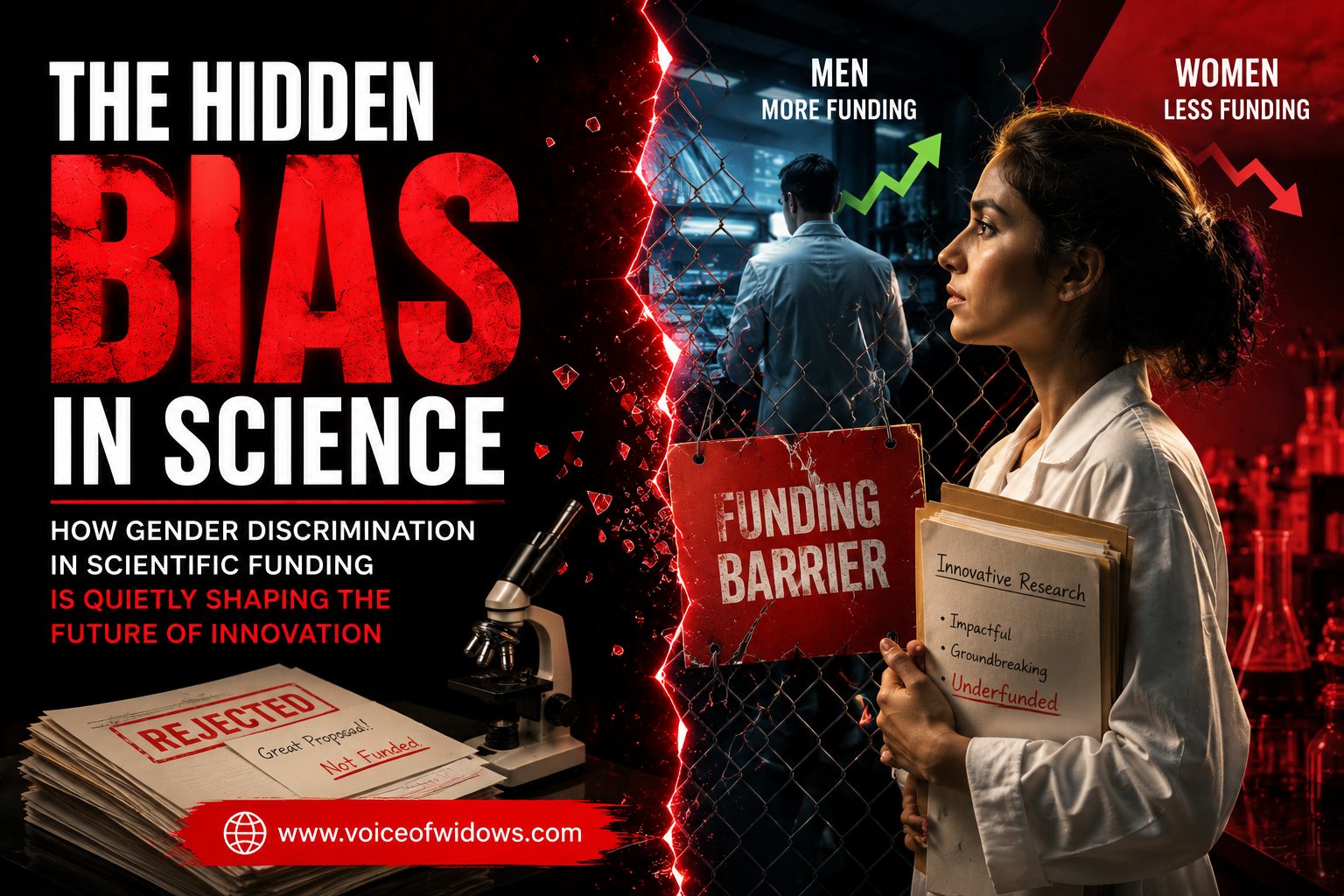
The Hidden Bias in Science: How Gender Discrimination in Scientific Funding Is Quietly Shaping the Future of Innovation
Introduction: When Talent Is Not Enough Science is supposed to be the purest form of meritocracy, where ideas compete and evidence decides outcomes. Yet behind the lab doors and grant review panels, a quieter reality persists: gender discrimination in scientific funding is still shaping who gets to discover, innovate, and lead. This is not just a fairness issue. It is a global innovation problem. Every underfunded researcher is a lost opportunity for breakthroughs in medicine, climate science, engineering, and technology. The question is no longer whether bias exists, but how deeply it is embedded in systems that decide the future of science itself. The Invisible Barrier in Research Funding Scientific funding is often perceived as objective. Proposals are reviewed, scored, and awarded based on merit. But research over the past decades consistently reveals patterns that challenge this belief. Women researchers, even when equally qualified, are less likely to receive large-scale grants, long-term funding, or leadership positions in high-budget projects. The disparity becomes more visible in fields traditionally dominated by men such as physics, engineering, and computational sciences. The issue is not always explicit discrimination. It is often subtle, structural, and embedded in evaluation criteria, unconscious bias, networking advantages, and historical inequalities. How Bias Quietly Enters Funding Systems Gender discrimination in scientific funding does not usually appear as open exclusion. Instead, it manifests through layered mechanisms: 1. Evaluation Bias Grant proposals written by women are sometimes judged more critically, with higher scrutiny on methodology and feasibility, while similar proposals from men are evaluated more leniently. 2. Network Advantage Funding decisions are influenced by professional networks. Historically male-dominated academic circles often provide better access to mentorship, collaborations, and informal endorsements. 3. Leadership Perception Projects led by men are more likely to be perceived as “high impact” or “high risk-high reward,” even when proposals are scientifically equivalent. 4. Career Interruptions Women scientists disproportionately experience career breaks due to caregiving responsibilities. Funding systems often fail to account for these disruptions, penalizing productivity gaps. The Real Cost: What Science Loses This issue is not limited to individual careers. It reshapes the direction of global research. When funding is unevenly distributed: Entire research perspectives are underrepresented Medical studies may overlook gender-specific biological differences Innovation pipelines become narrower and less diverse Scientific leadership remains unbalanced The result is not just inequality. It is inefficiency in global knowledge production. Why This Problem Persists in Modern Science Despite awareness, gender inequality in funding persists due to deeply rooted structural reasons: Institutional Inertia Funding bodies often rely on traditional evaluation frameworks that were not designed to detect bias. Lack of Accountability Few systems track long-term gender outcomes in funding distribution. Implicit Bias Even well-intentioned reviewers may unconsciously associate leadership and innovation with masculine traits. Competitive Pressure High competition for limited funding encourages conservative decision-making, which often favors established, traditionally dominant profiles. The Emotional Reality Behind the Data Behind every statistic is a researcher who has spent years building expertise, designing experiments, and pushing the boundaries of knowledge—only to face repeated rejection that cannot always be explained by merit alone. This creates a silent psychological toll: Reduced confidence in grant applications Lower participation in high-impact research bids Gradual withdrawal from competitive funding arenas Over time, this does not just affect individuals. It reshapes entire scientific communities. What Needs to Change: Building Fair Scientific Funding Systems Addressing gender discrimination in scientific funding requires more than awareness. It demands structural reform. 1. Blind Review Processes Removing identifying information from proposals can reduce unconscious bias during evaluation. 2. Transparent Funding Metrics Clear reporting of funding allocation by gender, discipline, and institution can expose hidden disparities. 3. Bias Training for Review Panels Regular training can help evaluators recognize and mitigate unconscious assumptions. 4. Support for Career Breaks Funding agencies must adapt criteria to fairly assess productivity across non-linear career paths. 5. Inclusive Leadership in Funding Bodies Diverse decision-making panels lead to more balanced funding outcomes. Why This Matters for the Future of Innovation Science is entering an era defined by complexity—climate change, artificial intelligence, global health crises. Solving these challenges requires every available mind. If funding systems continue to filter talent through biased structures, the world risks losing transformative discoveries simply because the system failed to recognize them in time. Equality in scientific funding is not a symbolic goal. It is a strategic necessity for global progress. Conclusion: A System Worth Redesigning Gender discrimination in scientific funding is not always visible, but its effects are deeply embedded in the trajectory of science itself. It determines which ideas survive, which researchers lead, and which innovations reach the world. A fair scientific ecosystem is not one that assumes bias does not exist, but one that actively designs against it. The future of science depends on whether institutions are willing to question long-standing norms and rebuild funding systems that recognize talent without distortion. Because when science becomes truly inclusive, innovation does not just improve—it accelerates.

Unveiling Bias: Why the World Can’t Afford to Lose Women in STEM—and What Must Change Now
In every breakthrough that defines modern civilization—from artificial intelligence to medical innovation, from climate modeling to space exploration—there is a silent imbalance that continues to shape outcomes more than we admit. Women in STEM (Science, Technology, Engineering, and Mathematics) are still underrepresented, undervalued, and often overlooked despite their proven capabilities and contributions. This is not just a diversity issue. It is a global innovation crisis. The urgency is real, and the cost of ignoring it is growing every day. The Hidden Barrier No One Talks About Loud Enough Bias in STEM does not always appear as open discrimination. More often, it is subtle, structural, and deeply embedded in systems that appear neutral on the surface. It shows up when: Women’s ideas are less likely to be credited in research teams Leadership roles in tech and engineering are still overwhelmingly male-dominated Young girls are discouraged from pursuing math and science due to stereotypes Funding opportunities favor networks that exclude diverse voices Over time, these patterns create a pipeline problem—not because women lack ability, but because systems fail to retain and elevate them. Why This Matters More Than Ever in a Rapidly Changing World We are entering an era defined by artificial intelligence, biotechnology, automation, and space innovation. These fields are not just shaping industries—they are shaping humanity’s future. When half of the population is underrepresented in building that future, the consequences are far-reaching: Innovation becomes narrower and less inclusive Products and technologies risk being designed without diverse user perspectives Economic growth potential is left unrealized Global problem-solving capacity is weakened The question is no longer whether we can afford to support women in STEM. The real question is whether we can afford not to. The Early Drop-Off: Where the System Quietly Fails One of the most critical issues begins long before careers start. Many young girls show strong interest and performance in science and mathematics during early education. However, as they progress through school and into higher education, participation drops sharply. Why? Because interest alone is not enough when: Role models are scarce Classroom expectations are influenced by unconscious bias Confidence is undermined over time Career pathways are not clearly supported This is where the system quietly loses talent—not due to capability, but due to environment. The Workplace Reality: Progress That Is Still Incomplete Even for women who enter STEM careers, challenges often continue. Common barriers include: Unequal access to leadership opportunities Pay gaps that persist across industries Workplace cultures that lack inclusivity Higher scrutiny and lower tolerance for mistakes compared to peers Despite these challenges, women continue to lead groundbreaking work in fields like medicine, engineering, data science, and environmental research. The issue is not performance—it is recognition and opportunity. The Economic Argument That Cannot Be Ignored Supporting women in STEM is not just a moral or social priority. It is an economic necessity. Research consistently shows that diverse teams: Solve problems faster Produce more innovative solutions Improve organizational performance Enhance long-term profitability When industries exclude or limit women, they are effectively reducing their own competitive advantage. The global economy is evolving too fast for outdated talent systems to remain in place. What Real Change Actually Looks Like Awareness alone is not enough. Action must be structural, consistent, and measurable. Real progress includes: Early education reform that encourages girls in STEM from a young age Mentorship programs that connect students with female professionals in science and technology Transparent hiring and promotion systems that reduce bias Funding support for women-led research and startups Workplace policies that support retention, flexibility, and growth Change does not happen through isolated initiatives. It happens when inclusion becomes part of how systems operate by default. The Role of Society: Beyond Institutions and Into Culture While institutions play a major role, cultural attitudes are equally powerful. Stereotypes about “who belongs” in STEM still influence: Career choices Family encouragement Teacher expectations Peer perception Changing this requires consistent visibility of women succeeding in these fields—not as exceptions, but as normal leaders, innovators, and experts. Representation is not symbolic. It is transformative. A Future That Depends on Inclusion The future of STEM is not predetermined. It is being built right now—in classrooms, laboratories, tech companies, and research institutions around the world. If current patterns continue, the gap will persist. But if deliberate action is taken, the next generation could inherit a system that finally reflects true global talent. This is not about replacing one group with another. It is about unlocking the full capacity of human intelligence, creativity, and problem-solving. And that requires everyone. Final Thought The world does not lack talent. It lacks equal access to opportunity. Supporting women in STEM is not an optional improvement—it is a necessary correction for a system that is still evolving toward fairness and efficiency. The urgency is not in the future. It is already here.