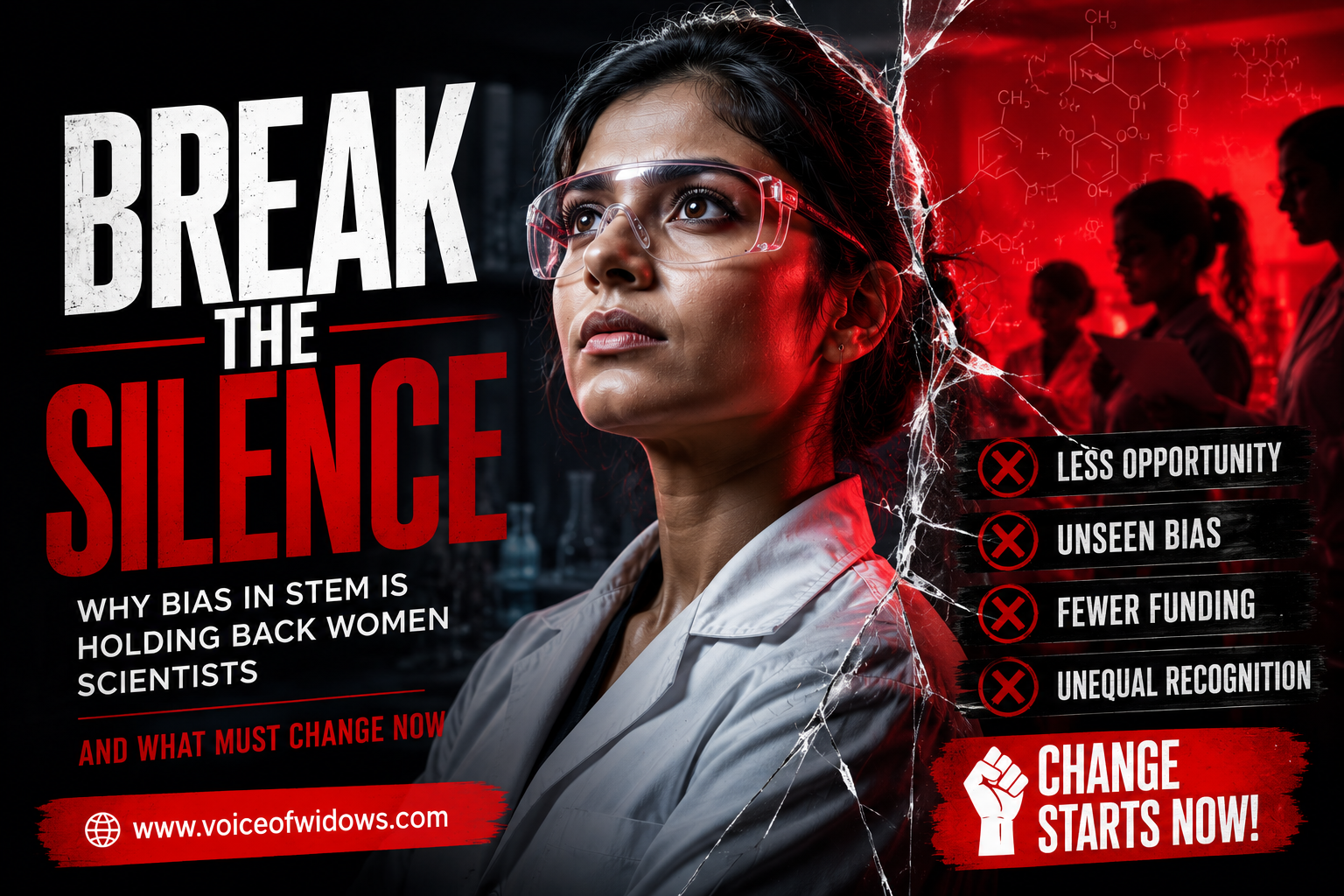
In laboratories, classrooms, research institutions, and innovation hubs across the world, a quiet imbalance still shapes outcomes that affect everyone. The question is no longer whether women belong in STEM fields—science, technology, engineering, and mathematics—but why systemic bias continues to limit their visibility, leadership, funding, and recognition.
This is not just a conversation about equality. It is a conversation about lost innovation, delayed discoveries, and untapped human potential.
The Hidden Barrier Behind Scientific Progress
STEM fields are built on logic, evidence, and merit. Yet behind the data-driven surface lies a persistent human bias that influences hiring decisions, grant approvals, publication opportunities, and leadership promotions.
Women scientists often face subtle but powerful barriers:
- Research contributions being undervalued or attributed to male colleagues
- Fewer opportunities for leadership roles in research projects
- Reduced access to funding and academic recognition
- Higher scrutiny for the same level of work
- Cultural expectations that discourage long-term STEM careers
These challenges do not always appear as open discrimination. Instead, they operate quietly through systems, traditions, and unconscious bias that accumulate over time.
Why This Issue Cannot Be Ignored Anymore
When women are excluded or limited in STEM, the cost is not individual—it is global.
Medical breakthroughs may be delayed because diverse perspectives are missing. Engineering solutions may lack inclusivity because design teams are not representative. Artificial intelligence systems risk inheriting bias when developed in homogeneous environments.
The world does not just lose fairness—it loses better science.
The urgency is clear: innovation depends on diversity of thought, and diversity cannot exist without inclusion.
The Emotional Reality Behind the Data
Behind every statistic is a story rarely told.
A young researcher who leaves academia after repeated rejection despite publishing strong work.
A brilliant engineer whose ideas are overlooked until repeated by a male colleague.
A scientist who hesitates to apply for leadership roles because she has been conditioned to doubt her place.
These are not isolated incidents. They reflect a pattern that discourages women from staying in STEM long enough to reach their full potential.
And when talent leaves, science loses momentum.
The Systemic Gaps That Sustain Bias
To understand the problem, we must examine the system itself:
- Education Pipeline Gaps
Girls often receive less encouragement in math and science during formative years, shaping career confidence early. - Workplace Culture Barriers
Many STEM environments still lack inclusive policies, mentorship structures, and flexible career pathways. - Funding Inequality
Studies repeatedly show women receive less research funding and smaller grants compared to male counterparts with similar credentials. - Visibility and Recognition Gap
Women are underrepresented in keynote speaking roles, award nominations, and high-impact publications. - Leadership Representation
Decision-making bodies in scientific institutions remain disproportionately male-dominated.
Each of these layers compounds the next, creating a cycle that is difficult to break without intentional intervention.
What Empowerment in STEM Actually Looks Like
Empowering women scientists is not about symbolic representation. It requires structural transformation.
True empowerment includes:
- Transparent hiring and promotion processes
- Equal access to research funding and resources
- Mentorship programs connecting early-career and senior women scientists
- Active bias training across institutions
- Policies that support work-life balance without penalization
- Recognition systems that fairly evaluate contributions
When these systems are in place, performance is no longer filtered through bias—it is evaluated through merit.
The Business of Inclusion: Why Organizations Should Care
Beyond ethics, there is a strong economic and innovation argument.
Organizations with gender-diverse research teams consistently outperform less diverse counterparts in creativity, problem-solving, and product development. In STEM-driven industries, this translates directly into competitive advantage.
In simple terms: excluding women from STEM is not just unfair—it is inefficient.
Forward-thinking institutions are already investing in inclusive research environments because they understand a critical truth: the future of science depends on who gets to participate in it.
A Turning Point: From Awareness to Action
Awareness alone is not enough. The challenge now is execution.
Educational institutions must redesign pathways that keep girls engaged in STEM from early education through university. Corporations and research bodies must audit internal systems for bias and actively correct disparities. Governments and funding agencies must enforce transparency in grants and leadership selection.
Most importantly, individuals within STEM fields must recognize their role in either reinforcing or dismantling bias.
Change does not happen in isolation. It happens through repeated, intentional decisions.
The Future We Risk Losing
Imagine a world where half of the brightest scientific minds are discouraged before they fully emerge. That is not a hypothetical—it is an ongoing reality shaped by bias.
Now imagine the discoveries that never happen because of it. The medical treatments not developed. The technologies not invented. The environmental solutions delayed.
The cost of exclusion is not theoretical. It is measurable in progress lost.
Conclusion: A Scientific Revolution Still Waiting to Happen
Bias in STEM is not a small flaw in an otherwise fair system. It is a structural issue that shapes the direction of global innovation.
Empowering women scientists is not a trend or a symbolic gesture—it is a necessary correction for science to reach its true potential.
The future of STEM depends on whether institutions choose to preserve outdated barriers or unlock the full spectrum of human intelligence.
The choice is not abstract. It is happening now.
And the impact will define the next century of discovery.