

Why Are Widowed Women Still Living in Fear? A woman loses her husband, and in a single moment, her entire world changes. Along with grief, many widows inherit something they never asked for: fear. Fear of financial uncertainty. Fear of social judgment. Fear of loneliness. Fear of exploitation. Fear of an uncertain future. In a world that speaks loudly about equality and progress, millions of widowed women still live silently behind closed doors, carrying emotional wounds and anxieties that society often refuses to acknowledge. The question we must ask ourselves is not whether widows are suffering. The real question is this: Why are widowed women still living with fear in the twenty-first century? The Grief That Never Fully Leaves Losing a life partner is one of the most painful experiences a human being can endure. Marriage is not merely a legal relationship. It is companionship, support, shared responsibilities, dreams, and emotional security. When a husband dies, a widow does not simply lose a spouse. She often loses her closest friend, her emotional anchor, and in many cases, her financial protector. While people around her slowly return to their normal lives, she continues fighting battles that nobody can see. Many widows spend years learning how to survive emotionally while carrying grief that never completely disappears. Financial Fear Becomes a Daily Reality For countless widowed women, financial insecurity becomes an immediate and frightening challenge. Many suddenly become solely responsible for: Paying bills Raising children Managing debts Handling legal documentation Maintaining a household Securing education for their children Women who previously depended on their husbands’ income may find themselves facing overwhelming responsibilities without adequate financial resources. This uncertainty creates constant anxiety. Questions repeatedly enter their minds: How will I support my family? Will I lose my home? Can I afford my children’s education? What happens if I become sick? Financial fear is one of the biggest reasons widowed women continue to live with constant stress and insecurity. Social Stigma Still Exists Despite social progress, widowhood remains surrounded by misconceptions in many communities. Some widows experience exclusion from social events. Some face unwanted pity. Others are unfairly blamed for circumstances beyond their control. Many feel invisible. Even more painful is when society begins to define a woman entirely by her loss rather than recognizing her strengths, abilities, and identity. A widow should never be treated as someone whose life has ended. She is still a mother, daughter, professional, leader, entrepreneur, friend, and valuable member of society. Yet social attitudes often make widows feel isolated and vulnerable. The Fear of Loneliness Loneliness can become one of the deepest wounds of widowhood. After years of sharing everyday experiences with a partner, silence suddenly fills the home. Simple moments become painful reminders: Eating alone Making decisions alone Celebrating milestones alone Facing illness alone Many widows admit that nights are often the hardest because grief becomes louder in silence. Humans are designed for connection, and prolonged loneliness can significantly affect emotional well-being and overall quality of life. Raising Children Alone Creates Enormous Pressure Widowed mothers frequently carry responsibilities that once belonged to two people. They become providers. They become protectors. They become emotional support systems. They become decision-makers. They become both mother and father. The pressure can be overwhelming. Many mothers suppress their own pain because they believe they must remain strong for their children. Yet inside, they continue living with fear and uncertainty. Fear of Exploitation and Vulnerability Widowed women can become targets of exploitation. Some face financial manipulation. Others encounter property disputes. Some experience workplace discrimination. Others struggle with harassment or coercive situations. When emotional vulnerability meets economic insecurity, fear naturally increases. Every society has a responsibility to protect widowed women from abuse, exploitation, and discrimination. No woman should have to fear becoming vulnerable simply because she lost her spouse. Mental Health Challenges Are Often Ignored The emotional impact of widowhood extends far beyond sadness. Many widows experience: Depression Anxiety Sleep difficulties Chronic stress Emotional exhaustion Loss of confidence Unfortunately, mental health support remains inaccessible or socially discouraged in many communities. People often tell widows to be strong and move on. But healing does not happen according to a schedule. Grief demands compassion, understanding, and support. Ignoring emotional pain only deepens suffering. Why Society Must Pay Attention Now Widowed women are not asking for sympathy. They are asking for dignity. They are asking for equal opportunities. They are asking for understanding. They are asking for security. They are asking for the freedom to rebuild their lives without fear. Every family, institution, and community has a role to play. Support systems should include: Emotional counseling Financial education Employment opportunities Legal assistance Community support networks Protection against discrimination Access to healthcare and mental health resources When widowed women are empowered, entire families and communities become stronger. The Conversation We Can No Longer Ignore The fear experienced by widowed women is not a personal failure. It is often the result of social neglect, inadequate support systems, and persistent stereotypes. The measure of a compassionate society is not how it treats people during moments of celebration. It is how it supports individuals during their darkest hours. Widowed women deserve more than sympathy. They deserve respect. They deserve opportunities. They deserve security. Most importantly, they deserve to live without fear. Perhaps the real question is not why widowed women are still afraid. The real question is this: What are we doing today to ensure that no widow has to face tomorrow alone?
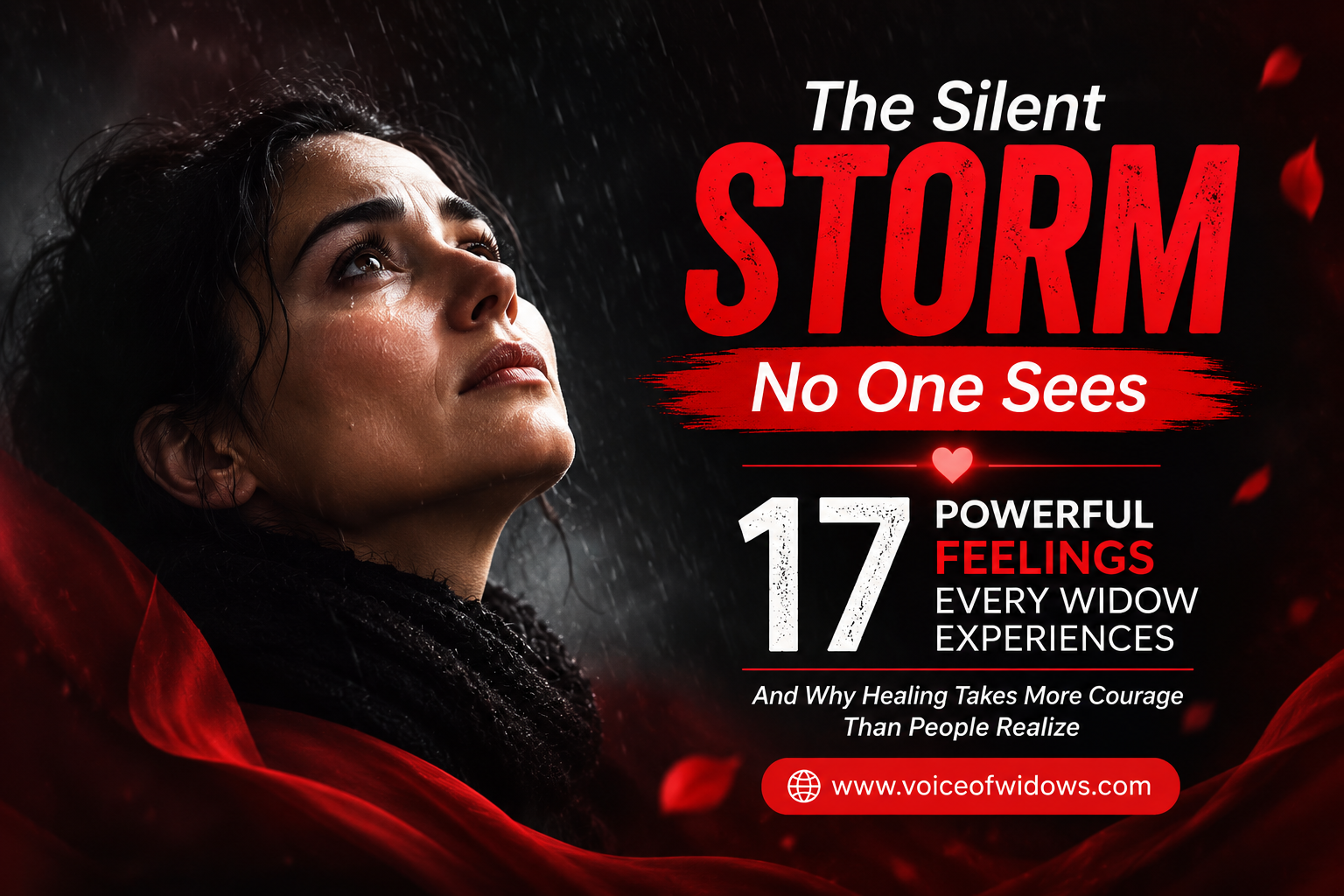
The Silent Storm No One Sees: 17 Powerful Feelings Every Widow Experiences And Why Healing Takes More Courage Than People Realize
A woman can prepare for many challenges in life, but few experiences compare to the emotional earthquake of losing a life partner. Widowhood is not simply about losing a husband; it is about losing a companion, a confidant, a future, shared dreams, daily routines, and a part of one’s identity. Behind every widow is a story that often remains untold. While friends and family may offer support during the first few weeks, many widows continue fighting silent battles long after the condolences stop arriving. Society often expects healing to happen quickly, yet grief follows no calendar. The emotional journey of widowhood is complex, unpredictable, and deeply personal. Some days bring strength and hope. Other days bring overwhelming sadness and uncertainty. Understanding these emotions can help widows feel less alone and help others provide meaningful support. Understanding the emotional reality of widowhood Grief is not a straight line. It moves in waves. A widow may feel acceptance one day and intense sorrow the next. These emotional shifts are normal and reflect the profound impact of losing a spouse. Below are seventeen powerful feelings many widows experience during their journey. 1. Shock The initial loss often feels unreal. Even when a spouse has been ill for a long time, the reality of death can be difficult to comprehend. Many widows describe feeling numb, disconnected, or unable to process what has happened. The mind struggles to accept a life-changing reality overnight. 2. Deep sadness Sadness becomes a constant companion during the early stages of widowhood. Simple moments can trigger tears—a favorite song, a familiar scent, an empty chair at dinner, or a photograph from happier times. This sadness reflects the depth of love that existed. 3. Loneliness One of the most painful aspects of widowhood is loneliness. The absence of daily conversations, shared routines, and companionship creates a silence that many find overwhelming. Even when surrounded by people, a widow may feel profoundly alone. 4. Fear of the future The future suddenly becomes uncertain. Questions begin to emerge: How will I manage financially? Who will support me emotionally? Can I handle life’s responsibilities alone? Fear often accompanies major life transitions, and widowhood is among the most significant. 5. Anger Many widows experience anger. They may feel angry about the illness, circumstances, medical challenges, or simply the unfairness of losing someone they love. Anger is a natural response to profound loss. 6. Guilt Guilt frequently appears during grief. Widows may replay conversations, decisions, or moments from the past, wondering if they could have done something differently. Many carry burdens that were never theirs to carry. 7. Confusion Widowhood often creates emotional and mental confusion. The brain is processing intense stress while trying to adjust to a completely different reality. Simple decisions can suddenly feel difficult. 8. Anxiety Many widows experience heightened anxiety. The uncertainty of life after loss can lead to constant worry about finances, health, family responsibilities, and future stability. Anxiety is often a reflection of the significant changes taking place. 9. Emotional exhaustion Grieving requires enormous emotional energy. Widows often report feeling physically and mentally drained, even when they have done very little during the day. Healing itself can be exhausting work. 10. Isolation Many widows feel disconnected from others. Friends may not understand their pain. Social invitations may decrease. Conversations can feel awkward. This sense of isolation can deepen grief if left unaddressed. 11. Loss of identity Many women have spent years or decades as wives. When a spouse dies, questions about identity often arise. Who am I now? What does my future look like? What role do I play in the world? Rediscovering oneself becomes an important part of healing. 12. Regret Widows may regret missed opportunities, unfinished conversations, or plans that never became reality. These feelings can linger for years if not acknowledged and processed. 13. Jealousy This emotion is rarely discussed but is surprisingly common. Seeing happy couples together can trigger feelings of envy or sadness. This reaction does not make a widow selfish; it reflects the longing for what has been lost. 14. Hope Amid the pain, hope eventually begins to emerge. Small moments of joy, meaningful friendships, personal growth, and new opportunities can slowly remind widows that life still holds possibilities. Hope often arrives quietly. 15. Strength Many widows discover resilience they never knew they possessed. Managing households, finances, family responsibilities, and personal healing reveals an inner strength that often surprises them. Strength is not the absence of pain; it is moving forward despite it. 16. Gratitude Over time, gratitude can coexist with grief. Many widows begin appreciating the memories, lessons, and years shared with their spouse. The pain of loss remains, but appreciation for the love experienced becomes stronger. 17. Acceptance Acceptance does not mean forgetting. It means acknowledging reality while continuing to live meaningfully. A widow learns that she can carry love and loss together. Acceptance represents a new chapter rather than an ending. Why understanding widowhood matters Millions of women around the world navigate widowhood every year. Yet many continue suffering in silence because society often misunderstands grief. People may encourage widows to “move on” before they are ready. Others may avoid discussing the loss altogether. Both responses can leave widows feeling unheard and unsupported. Understanding these emotions creates compassion. It reminds us that healing takes time and that every widow’s journey is unique. How widows can begin rebuilding their lives While grief never completely disappears, many widows find ways to move forward with purpose and hope. Some helpful steps include: Seeking emotional support from trusted friends and family. Joining widow support groups. Practicing self-care and self-compassion. Creating healthy daily routines. Pursuing new interests and personal goals. Allowing themselves permission to heal at their own pace. Honoring memories while embracing future possibilities. The goal is not to forget the person who was lost. The goal is to learn how to carry that love into the next chapter of life. The hidden truth about widowhood The strongest widows are not those who never
The Silent Struggle: Daily Challenges Faced by Single Parents and How to Overcome Them
Being a single parent is often portrayed as a simple role, but the reality is far from it. Every day, millions of single parents around the world wake up to a whirlwind of responsibilities, juggling careers, child-rearing, household management, and emotional well-being. This journey, while full of love and devotion, is also marked by stress, sacrifice, and constant decision-making under pressure. 1. Financial Pressure That Never SleepsOne of the most overwhelming challenges single parents face is financial strain. Unlike two-parent households where responsibilities and expenses are shared, single parents often bear the full burden of bills, childcare costs, education, and unexpected emergencies. This constant financial juggling creates stress and anxiety that can affect both the parent and the child. The urgency to secure a stable income can push single parents into long working hours, sometimes sacrificing personal health and time with their children. 2. Emotional Overload and IsolationSingle parents frequently battle emotional exhaustion. Handling the mental load of parenting alone—deciding what’s best for the child, maintaining discipline, and managing personal emotions—can be isolating. Feelings of loneliness often creep in when friends and family are unavailable, or societal judgment adds pressure. Emotional support becomes crucial, yet many single parents struggle to find a safe space to share their worries without feeling guilty. 3. Time Management and Life BalanceManaging time is another relentless challenge. From school drop-offs to work meetings, medical appointments, and household chores, single parents often feel like they are on a non-stop treadmill. There’s little room for personal rest or self-care, making burnout a common reality. Children notice their parent’s stress, which can impact family dynamics and the emotional health of the household. Finding practical strategies to balance work and life is essential, but often requires creative thinking and community support. 4. Social Stigma and JudgmentSociety often places invisible expectations on single parents, questioning their ability to provide or judging their choices. This stigma can create unnecessary pressure, making parents feel undervalued or criticized for circumstances that are often beyond their control. Breaking free from judgment and building confidence in parenting decisions is a continuous and empowering process. 5. Parenting Challenges Without a PartnerParenting alone comes with unique challenges. Single parents must make decisions without a co-parent’s perspective, handle discipline on their own, and provide emotional support to children who may also feel the void of a missing parent. This can be emotionally taxing, especially during critical phases of a child’s growth. The ability to remain patient, consistent, and nurturing, while also managing personal stress, is a skill single parents continuously develop. How Single Parents Can Overcome Daily Challenges – Build a Support Network: Surround yourself with friends, family, or support groups who can offer emotional and practical assistance. Sharing responsibilities, even occasionally, can dramatically reduce stress. – Prioritize Self-Care: Single parents must remember that taking care of themselves is not selfish. Adequate rest, nutrition, exercise, and time for hobbies improve resilience and parenting effectiveness. – Financial Planning and Assistance: Budgeting wisely, seeking financial advice, or applying for community aid programs can ease financial stress. Small, consistent steps toward financial stability can create long-term security. – Open Communication With Children: Explaining situations age-appropriately to children helps them understand and cope with family dynamics. It builds trust, empathy, and stronger bonds. – Professional Guidance: Counseling or coaching, both for personal well-being and parenting strategies, can provide actionable insights to navigate the complexities of single parenting. ConclusionBeing a single parent is not a choice but a courageous journey filled with love, challenges, and growth. Recognizing the daily struggles while actively seeking solutions empowers both parent and child. Every effort counts, and no parent should feel alone in this battle. With support, planning, and self-care, single parents can not only survive but thrive, creating a positive environment where their children flourish.

Raising A Life Alone: The Silent Strength, Sacrifice, And Unbreakable Courage Of A Single Parent
The struggle of a single parent is not loud, but it is relentless.It unfolds quietly before sunrise and long after the world has gone to sleep. It lives in alarm clocks that ring too early, meals stretched too thin, and hearts that carry both exhaustion and fierce love at the same time. This is not just a story of hardship. This is a story of resilience, responsibility, and an everyday bravery that rarely gets applause. Single parenthood is not a choice for many. It is a situation shaped by loss, separation, survival, or circumstance. Yet once inside it, there is no pause button. There is no backup shift. There is only the parent and the child, navigating life together with limited hands and unlimited responsibility. The emotional weight no one prepares you for A single parent carries more than bills and schedules. They carry emotional pressure that never fully rests. Every decision feels heavier because there is no second voice in the room. From education choices to health concerns, from discipline to encouragement, the responsibility is singular and absolute. Loneliness often hides behind strength. Many single parents smile in public while silently worrying at night. Am I doing enough. Am I enough. Did I make the right decision. These questions echo constantly, yet the next morning still demands action, energy, and hope. Financial strain that shapes daily life Money is not just a concern. It is a daily calculation. Rent, food, school fees, medical needs, transportation, and emergencies compete for limited income. One unexpected expense can disrupt months of planning. Single parents often sacrifice personal needs without hesitation. New clothes, rest, health checkups, and dreams are postponed so children do not feel the impact. This financial pressure does not weaken them. It sharpens their survival instincts. But it should never be ignored or minimized. Time poverty and constant exhaustion Time becomes the rarest resource. Balancing work, childcare, household duties, and emotional presence leaves little room for rest. There are no shared night shifts. No one else to take over when sickness hits or energy collapses. Burnout is common, yet many single parents keep going because stopping is not an option. They function on discipline, love, and determination, even when their bodies beg for rest. The invisible guilt single parents carry Even while doing everything possible, guilt often follows. Guilt for missing school events due to work. Guilt for being tired. Guilt for not giving children the ideal family structure society promotes. But children do not measure love by numbers. They measure it by presence, consistency, and care. A single parent who shows up every day builds emotional security stronger than any perfect image. Strength built in silence Single parents become problem solvers, planners, nurturers, and protectors all at once. They learn skills they never expected to master. They develop emotional intelligence quickly because they must. Their children often grow up witnessing responsibility, empathy, and resilience firsthand. This lived example becomes a powerful lesson that no textbook can replace. Why this struggle demands attention now Ignoring the challenges of single parents creates generational consequences. When support systems fail, stress transfers to children. When society overlooks these families, inequality deepens. Single parents do not need sympathy. They need understanding, policy support, workplace flexibility, community inclusion, and respect. Every institution that interacts with families must ask one simple question. Are we making this easier or harder for a single parent to survive. What single parents need today They need flexible work environments that respect caregiving realities. They need affordable childcare and accessible healthcare. They need emotional support systems that reduce isolation. Most importantly, they need recognition that their role is not incomplete, broken, or lesser. A call to act, not just to feel If you are a single parent reading this, your struggle is valid and your strength is real. Asking for help is not weakness. Rest is not failure. You are building a life under pressure, and that deserves respect. If you are not a single parent, your awareness matters. Support policies that protect families. Offer understanding instead of judgment. Create spaces where single parents are seen, heard, and supported. The struggle of a single parent is not a personal failure.It is a social responsibility.It is a shared challenge.And it is a testament to human resilience when love refuses to give up.
Unbreakable Hearts and Relentless Strength: The Silent Battles and Triumphs of Single Motherhood
The unseen weight single mothers carry every single day Single motherhood is not a phase. It is not a temporary inconvenience. It is a full-time reality built on sacrifice, resilience, and quiet courage. Behind every school run, late-night work shift, unpaid bill, and exhausted smile is a woman carrying responsibilities meant for two or more people, alone. Society often celebrates strength in loud ways, but the strength of a single mother is silent. It shows up at dawn when she wakes before her children to plan the day. It shows up at night when fear, uncertainty, and fatigue collide, yet she keeps going because stopping is not an option. This is not just a story about struggle. It is a call to see, understand, and act. Financial pressure that never pauses Money is not just a concern for single mothers. It is a constant presence, shaping every decision. One income must stretch across rent, food, school fees, healthcare, childcare, transport, and emergencies that never announce themselves in advance. Every unexpected expense becomes a crisis. A sick child can mean missed work. Missed work can mean lost income. Lost income can mean falling behind, and catching up feels impossible. Yet many single mothers become financial strategists without training. They budget with precision, prioritize with discipline, and sacrifice their own needs first. New clothes, rest, healthcare, and dreams are postponed so children can have stability. This pressure does not build character. It drains energy, health, and hope. And it demands urgent attention from communities, employers, and policymakers. Emotional labor that no one applauds Single mothers do more than provide. They regulate emotions, manage conflicts, offer comfort, discipline with care, and become both protector and nurturer. They carry their children’s fears, questions, and heartbreaks while hiding their own. There is no one to share decisions with. No one to say you are doing the right thing. No one to step in when exhaustion hits its peak. The mental load is relentless and invisible. Loneliness becomes a quiet companion. Even surrounded by people, many single mothers feel unseen and unheard. They are expected to be strong, but rarely asked how they are truly coping. Ignoring this emotional toll is dangerous. Mental health support is not optional. It is essential. Social judgment and harmful narratives Single mothers face judgment that cuts deep. Assumptions are made about their choices, morality, and capabilities. Their success is minimized. Their struggles are blamed on personal failure rather than systemic gaps. These narratives do real damage. They isolate women who already feel overwhelmed. They discourage seeking help. They normalize neglect instead of responsibility from society. Single motherhood is not a weakness. It is a circumstance shaped by loss, separation, abuse, widowhood, or choice. Every story is different, and none deserve shame. The impact on children and the hidden fear mothers carry Single mothers often worry not about themselves, but about what their children might miss. Time. Presence. Opportunities. A second parent. They fear being stretched too thin. They fear burnout. They fear failing the people they love most. Yet research and real life show something powerful. Children raised by supported, emotionally available single mothers can thrive. Love, stability, and security matter more than household structure. Supporting a single mother is supporting the future of a child. Why urgency matters now more than ever Rising living costs, unstable job markets, and limited childcare options have made single motherhood harder than ever. Delaying action means deepening inequality, poverty, and emotional harm. Urgency is not panic. Urgency is responsibility. Employers must create flexible, fair workplaces. Governments must strengthen childcare, healthcare, and housing support. Communities must replace judgment with assistance. Families must step in instead of stepping away. And single mothers must be empowered, not pitied. A call to action that cannot wait If you are a single mother, your struggle is real and valid. Seeking support is not weakness. It is wisdom. Your well-being matters as much as your children’s. If you know a single mother, do more than admire her strength. Offer practical help. Listen without fixing. Advocate when she is too tired to speak. If you shape policies, platforms, or workplaces, build systems that recognize real lives, not ideal ones. Single motherhood does not need sympathy. It needs support, respect, and action. Because when a single mother is supported, an entire generation stands stronger.

To the Single Mom: You Were Never Meant to Carry the World Alone
A Letter of Truth, Strength, and Liberation Dear Single Mom, This is for you, the woman who wakes before the sun and sleeps long after everyone else has closed their eyes. This is for you, the one who wipes tears, ties shoelaces, packs lunches, pays bills, solves problems, and still manages to show up with a brave face. Society often tells you that you must be everything at once, but that message is unfair, heavy, and deeply unrealistic. You are strong, but strength does not mean silence. You are capable, but capability does not mean isolation. You are resilient, but resilience does not mean you must suffer alone. The narrative that single mothers must “do it all” is not empowerment, it is exhaustion dressed up as praise. And it is time to challenge that story. You Are Not a Burden, You Are a Builder Every day you are building lives, character, dreams, and stability for your children. That is not small work, it is sacred work. Yet the world often overlooks your effort, minimizing your struggles while expecting perfection from you. That is not fair, and you deserve better. Being a single mom does not mean you are broken, failed, or incomplete. It means you stepped up when circumstances changed. You chose responsibility over escape. You chose love over fear. That choice alone makes you extraordinary. The Danger of “Doing It All” Alone When you try to carry everything by yourself, you risk burnout, anxiety, and emotional depletion. You may feel guilty asking for help, but asking for support is not weakness, it is wisdom. No one is meant to survive life alone, not even superheroes. You do not need to prove your worth through suffering. You do not need to collapse in silence to be respected. You are allowed to rest, to ask, to share, to cry, to speak up, and to be supported. Your Children Need a Healthy You, Not a Perfect You Your children do not need a flawless mother, they need a present, peaceful, and emotionally well mother. When you allow yourself to receive help, you teach them an important life lesson, that community matters, vulnerability is human, and love is not a solo journey. A calm mother raises calmer children. A supported mother raises secure children. A mother who values herself raises children who value themselves. You Are More Than Survival, You Are Meant for Growth Your story does not end with struggle. It evolves into growth, opportunity, and purpose. You are allowed to dream again, to build a career, to pursue education, to nurture friendships, and to invest in your own happiness. Your identity is not limited to motherhood. You are also a woman with talents, passions, ideas, and a future that deserves attention. A Call to Action for Every Single Mom Reading This Stop carrying guilt that is not yours. Stop shrinking your voice. Stop believing that asking for help makes you less. Start seeking support, building community, and protecting your mental health. Reach out to another single mom, join support groups, talk to a counselor, lean on trusted family members, and most importantly, be kinder to yourself. Your life is not a punishment, it is a mission. Your challenges are not your shame, they are your testimony. And your future is not defined by your past, it is shaped by your courage today.

From Loss to Leadership: Voice of Widows and The Furniture Times Unite to Redefine CSR with Purpose, Power, and Lasting Impact
Some partnerships are strategic. Some are symbolic. And then there are partnerships that change lives.The collaboration between Voice of Widows – Turning Sorrows into Strength and The Furniture Times belongs to the rare third category. This is not just a Corporate Social Responsibility feature. This is a public commitment to humanity, dignity, and long-term empowerment. It is a declaration that business influence, when guided by conscience, can rewrite destinies. Voice of Widows is not a campaign. It is not charity. It is a movement born from pain and rebuilt through purpose.Across societies, widows are often left behind in silence, burdened not only by grief but by social neglect, economic vulnerability, and invisibility. Voice of Widows exists to confront that reality head-on. It transforms loss into leadership by creating pathways where widows are not pitied, but empowered. Where they are not dependent, but independent. Where their identity is not defined by what they lost, but by what they can build. The Furniture Times, as a leading voice in industry and innovation, choosing to feature Voice of Widows as a CSR partner is both powerful and timely.It sends a clear message that responsibility does not end at profit margins. It begins with people. By amplifying this initiative, The Furniture Times has used its platform not just to inform, but to inspire action, awareness, and accountability across industries. At the heart of Voice of Widows is a simple but radical belief: empowerment begins with opportunity, not sympathy.Rather than offering short-term relief, the initiative focuses on sustainable change. Through structured skill development programs, vocational training, entrepreneurship guidance, and livelihood creation, widows are equipped to rebuild their lives with confidence and economic stability. This approach ensures dignity is preserved, self-worth is restored, and futures are secured. Training without mentorship fails. Support without access collapses. Voice of Widows understands this deeply.That is why the initiative integrates mentorship, market exposure, and income-generating pathways into its model. Women are not only trained but guided. Not only supported but trusted. This ecosystem enables widows to transition from survival to self-reliance, from uncertainty to ownership. What makes this initiative exceptional is its refusal to let silence continue.Voice of Widows creates space for unheard voices to be acknowledged. It restores agency where society has imposed limitations. It nurtures resilience where vulnerability once lived. This is empowerment that is practical, emotional, and transformative. The Furniture Times featuring this initiative is more than recognition. It is reinforcement.It reinforces the idea that media platforms have moral power. That industries can influence social narratives. That CSR, when done right, is not about optics but outcomes. This collaboration stands as an example to brands, corporations, and institutions that real impact comes from aligning visibility with values. The urgency of this work cannot be overstated.Every day, countless widows face economic hardship, social exclusion, and limited opportunities. Delaying action means delaying dignity. Ignoring the issue means enabling inequality. Voice of Widows responds to this urgency with structure, vision, and measurable impact, proving that transformation is possible when intention meets execution. This partnership is a thank you, but it is also a call to action.A call to businesses to rethink CSR as a responsibility, not a requirement. A call to leaders to invest in long-term empowerment, not temporary solutions. A call to society to listen, support, and stand beside women who are ready to rise, if only given the chance. Voice of Widows is turning sorrows into strength. The Furniture Times has chosen to amplify that strength. Together, they are shaping a future where loss does not define a woman’s destiny, and empowerment is not an exception, but a standard. This is how change looks when purpose leads. This is how voices become movements. This is how responsibility becomes legacy.

The Silent Question: Why Do Most Widows Never Remarry? A Powerful Truth Society Must Finally Hear
There is a question that lingers quietly inside countless lives, a question that is rarely spoken aloud but deeply felt: Why do most widows never remarry?Behind the statistics are women whose lives were split into “before” and “after.” Their love stories did not fade away. They were torn apart. And when the world expected them to move on, many chose instead to rebuild not by replacing, but by rising. This is not a story about loneliness.It is a story about strength, memory, identity, and the invisible weight that widows silently carry every single day. The Unseen Grief That Never Fully Ends When a spouse dies, the world does not simply become quieter.It becomes unfamiliar. Routines collapse. Shared laughter becomes a memory. The future that was once planned together suddenly disappears. For many widows, love does not die with a person. It remains living inside them, shaping their choices forever. Remarriage, then, is not simply about finding a new partner.It is about standing face-to-face with the lingering echo of a love story that once defined everything. And for many, that love was enough. A New Identity Is Born From Loss Widows often discover a strength they never expected. They become decision makers, protectors, providers, and healers. Their independence is not a rebellion against love. It is survival. They learn to: manage life alone protect their children carry emotional scars quietly rebuild their sense of self By the time society begins questioning why they have not remarried, many widows have already formed a powerful identity rooted in resilience. They are no longer seeking to be completed. They already are. The Emotional Barrier Few Understand To love again can mean reopening a heart that has already been shattered once.For many widows, the thought of risking that level of loss again feels unimaginable. The fear is real.The grief is real.The loyalty to a memory is real. And sometimes, the heart simply decides once was enough. Social Pressure Makes It Even Harder Widows carry expectations placed upon them by society, culture, family, and community. Judgment whispers around them: Why are you still single?Are you being fair to your children?Have you moved on yet? These questions wound.They imply a deadline for grief, as though healing must follow a schedule. But grief follows no timeline.And love cannot be replaced like an object. A Love That Becomes Eternal Many widows do not remarry because they do not feel single. They still speak to their late spouse in quiet moments.They still sleep on one side of the bed.They still remember shared birthdays, first meetings, and last words. This is not weakness.It is loyalty born from genuine love. Some love stories do not end.They simply change shape. Practical Realities Also Matter Many widows also face: legal complications inheritance concerns financial responsibilities blended family challenges emotional needs of children Remarriage is not a simple decision. It affects lives beyond their own. And Then There Is Strength Widows learn to rebuild.They learn to breathe again.They learn to carry pain with grace. They become emotionally powerful.Independent.Grounded. And sometimes, they discover they no longer need romantic partnership to feel whole. This Is A Call To Compassion Before anyone asks a widow why she has not remarried, they should instead ask: How can I support you?How have you been coping?What does healing look like for you? Because the truth is simple: Most widows do not refuse remarriage out of fear of love.They simply already experienced a love that shaped their soul. And for many, that love will always be enough. A Final Thought For Every Reader Let this message awaken empathy.Let it remind us that grief is sacred.Let it teach us that women who walk through widowhood do not need pressure to begin again. They deserve respect for surviving.They deserve honor for enduring.They deserve peace — on their own terms. And if a widow chooses to love again, it is beautiful.If she does not, it is equally powerful. Because healing is personal.And love never truly leaves.


Shattering the Silence: The Unspoken Stigma Against Widows And Why It Must End Now
There is a powerful truth many societies still refuse to face: when a woman loses her husband, she is often forced to lose her identity too. The world may speak of compassion, but too often widows are quietly pushed to the margins—judged, pitied, excluded, and blamed for a tragedy they never chose. This stigma is ancient, but it lives loudly in the present. And until we confront it, millions of women will continue to suffer in silence. Widowhood is not only loss. For many women, it becomes a lifetime sentence of isolation. They are labeled instead of understood. They are watched instead of supported. They are questioned instead of comforted. In some communities, widows are told to dim their light, limit their happiness, and live in the shadow of grief indefinitely—as if joy becomes forbidden once their marital status changes. This is not culture. This is injustice. Where Does This Stigma Come From? The stigma against widows is rooted in fear, control, and harmful tradition. In many parts of the world, a woman’s worth has long been tied to marriage. When her husband dies, society treats her as incomplete, unsafe, or even unlucky. Some widows are denied inheritance. Some are stripped of dignity and choice. Some are silently punished for simply surviving. Widowhood should never equal guilt. Yet many women are made to feel responsible for what happened. And the tragedy deepens when children are involved. A grieving mother is expected to be strong, stable, and silent—all at the same time. But who supports her? The Emotional Cost No One Sees Widows experience a double grief: the loss of their partner and the loss of their place in society. Friends disappear. Invitations stop. People whisper. Judgment replaces compassion. And slowly, confidence fades. Imagine walking through life with your identity constantly questioned. Imagine being told you should “know your limits.” Imagine being treated as fragile, yet expected never to fall apart. This is the reality for too many widows. We Must Change This Now Widows do not need pity. They need power, dignity, and opportunity. They deserve: Respect. Inclusion. Financial independence. Emotional safety. Community support. Freedom to rebuild. Every widow is still a woman with dreams, skills, passion, and purpose. Her story did not end. It transformed. And we, as a society, must transform with it. It Starts With Us Speak up when you see discrimination. Include widows in conversations, celebrations, and decisions. Empower them with education, employment, and legal protection. Treat widowhood as a life transition — not a life sentence. When we uplift widows, we uplift families. When we restore their dignity, we restore humanity. Changing mindset is not optional. It is urgent. To Every Widow Reading This You are not defined by loss. You are not a burden. You are not invisible. Your strength is real. Your story matters. Your future is still bright. And you deserve a world that stands beside you — not against you. The Movement Begins With Awareness And Action Let this be the beginning of a louder conversation. A conversation that challenges stereotypes. A conversation that protects dignity. A conversation that finally breaks the silence. Because the stigma against widows should never have existed — and together, we can end it.