Introduction: When Life Changes Without Warning
Becoming a widow is not just a change in relationship status. It is a profound shift in identity, emotional stability, financial structure, and the way the world is experienced daily. Many women describe it as standing in a life that still looks familiar, but no longer feels like their own.
The question is not only “how do widows move forward,” but also “how do they begin again when everything feels paused?”
There is no single roadmap. But there is a process of rebuilding that is real, human, and possible.
Understanding the Emotional Reality of Loss
Grief is not linear. It does not follow a schedule or behave predictably. For widows, it often comes in waves—sometimes quiet, sometimes overwhelming.
Common emotional experiences include:
- Deep loneliness even in crowded spaces
- Loss of shared identity and daily routines
- Guilt about moments of peace or laughter
- Fear of an unknown future
- Emotional numbness followed by intense sadness
These reactions are not signs of weakness. They are natural responses to attachment and loss.
Healing does not mean forgetting. It means learning how to carry memory without being trapped by it.
The First Step Forward: Stabilizing Daily Life
Before emotional rebuilding begins, life often requires structure.
Simple stabilizing actions include:
- Creating a consistent daily routine
- Managing essential financial and legal matters gradually
- Maintaining basic health habits like sleep, meals, and hydration
- Staying connected to at least one trusted person regularly
These steps may feel small, but they create psychological grounding. Stability is the foundation on which emotional recovery is built.
Rebuilding Identity Beyond the Role of “Wife”
One of the most difficult transitions is identity loss. For many years, life may have been shaped around partnership, shared decisions, and mutual roles. After loss, that identity feels disrupted.
Rebuilding identity can include:
- Reconnecting with personal interests that were paused
- Exploring new skills or learning paths
- Rediscovering social circles and friendships
- Allowing personal desires and goals to re-emerge
This stage is not about replacing what was lost. It is about expanding who you are beyond what was once shared.
The Role of Emotional Expression in Healing
Suppressing grief often delays recovery. Emotional expression is not a sign of breaking down; it is a sign of processing.
Healthy emotional outlets include:
- Journaling thoughts without judgment
- Speaking with grief counselors or support groups
- Creative expression such as writing, art, or music
- Honest conversations with trusted people
Healing happens when emotions are acknowledged, not avoided.
Facing Loneliness Without Letting It Define You
Loneliness after loss is not just about absence of people—it is about absence of connection, rhythm, and shared meaning.
Ways to gently rebuild connection include:
- Joining community or interest-based groups
- Volunteering or participating in social causes
- Re-establishing friendships without pressure or expectations
- Creating small daily moments of interaction
Connection does not replace loss, but it softens isolation.
Financial and Practical Independence After Loss
For many widows, financial uncertainty adds another layer of stress. Addressing it step-by-step reduces anxiety and increases control.
Practical steps may include:
- Reviewing financial accounts and documentation
- Seeking professional financial advice if needed
- Exploring sustainable income opportunities or skills training
- Planning long-term financial security gradually
Clarity in practical matters often supports emotional clarity as well.
When the Future Feels Empty
One of the hardest parts of widowhood is imagining a future that no longer includes shared dreams.
But future-building does not require forgetting the past. It requires redefining it.
A meaningful future may begin with:
- Small personal goals instead of long-term pressure
- Travel, learning, or lifestyle changes that feel authentic
- Reclaiming independence in decision-making
- Allowing joy to return without guilt
Hope does not appear all at once. It grows slowly through lived experience.
Moving Forward Is Not Moving On
There is a misunderstanding that healing means “moving on.” In reality, widows do not move on from love—they move forward with memory.
Moving forward means:
- Carrying love without being defined only by loss
- Accepting change without denying the past
- Rebuilding life while honoring what existed
- Allowing both grief and growth to coexist
This is not about closure. It is about continuation in a different form.
Conclusion: A Life That Still Belongs to You
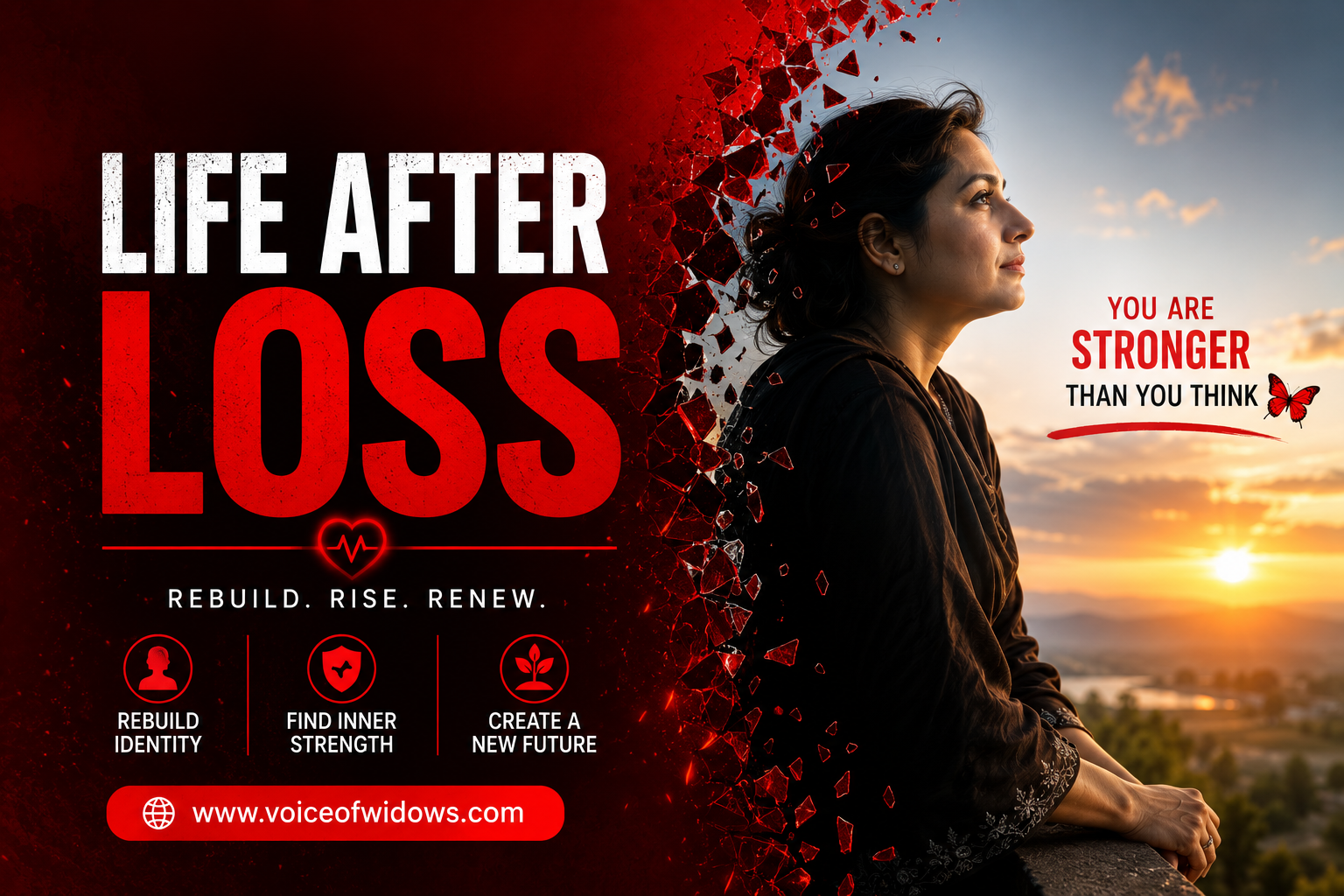
Widowhood changes everything, but it does not end identity, purpose, or possibility. Life after loss is not a replacement life—it is a reconstructed one.
The process is not fast. It is not simple. But it is real.
And step by step, life begins to open again in ways that are not about forgetting, but about becoming whole in a new way.